The risk usually shows up in one place: the spot where a big tree divides into two trunks. If that union starts to split, the next heavy storm can take half the tree down, often onto whatever is underneath it. Cabling and bracing are the usual answer to that problem, and they’re the reason a tree that looks doomed can sometimes stay. But they’re support, not repair, and they aren’t right for every tree.
The short answer: cabling and bracing are support systems installed in a tree to limit how much a weak part can move. Cabling uses flexible cable high in the canopy to limit movement between two leaders or heavy limbs. Bracing uses rigid rods through a weak union or a split to hold the parts together. Neither one repairs decay, and neither makes a tree safe. They reduce the chance of one specific failure in a tree that is otherwise worth keeping, and they commit the owner to having that hardware checked for as long as the tree stands.
What the two systems are
The International Society of Arboriculture’s best practice guide for this work covers cables, braces, guys and props, and describes them as hardware that can “effectively limit the movement of branches, leaders, or entire trees” (ISA, Best Management Practices: Tree Support Systems). That phrase is the useful part: these systems limit movement. They don’t add strength to wood that has already failed.
- Cabling is the flexible half. Cable is installed high in the crown, between limbs or leaders, so that the two parts can’t move independently in a way that levers the union apart.
- Bracing is the rigid half. Rods are installed through the weak union or the split itself, holding both sides together.
The two are often used on the same tree, since a split union usually needs both the rods across the crack and the cable above it.
The guide is a companion to the ANSI A300 standards, the written standards for tree care work in the United States. That matters for a practical reason: the research on these systems is based on hardware installed to that standard.
Why weak unions fail in the first place
Most cabling work traces back to how the tree grew, usually long before anyone thought about it.
A tree with two trunks of roughly equal size, called codominant stems or a double leader, is weaker where they meet than a tree with one central trunk and smaller side branches. The University of Maryland Extension’s guidance on pruning is blunt about it: if a young tree has co-dominant stems, remove one “to avoid structural weakness” (University of Maryland Extension).
The other half of the problem is included bark. When two stems grow tightly together, bark gets trapped inside the union instead of wood knitting across it. The same Extension guidance describes how the bark becomes enclosed in the crotch, “which leads to weakness and branch failure or dieback”. A union with included bark can look completely solid from the ground and still be the weakest point in the tree.
On a young tree, the fix is pruning. On a mature tree, removing one of two 60-foot trunks isn’t pruning any more, and that’s where support systems come in.
Montclair, NJ
Worried about a split or a double trunk?
A look at the tree is the only way to tell whether support is realistic.
Request a site visit
When a tree is a candidate, and when it isn’t
A tree is a candidate when the defect is specific, the wood that has to hold the hardware is sound, and the rest of the tree is worth keeping. So the decision isn’t really about the crack. It’s about everything around it.
- Is the rest of the tree worth keeping? Support hardware is a long-term investment in one tree. A tree in decline, or one that would need large amounts of deadwood removed every year anyway, is a poor candidate.
- How much decay is in the wood that has to hold the hardware? Cables and rods anchor into wood. Wood that is soft or hollow can’t be relied on to hold them.
- How big is the defect? A hairline crack at a union and a trunk split halfway to the ground are different problems with different odds.
- What’s underneath? A tree over a driveway, a house or a play area is judged differently from the same tree in open lawn, because the consequence of failure is different.
- Can it be reached and maintained? Hardware that can’t be inspected isn’t much use.
A good arborist will sometimes tell you the honest answer is removal. That’s not a sales position, it’s the same assessment arriving at a different conclusion: when the wood that would carry the hardware isn’t sound, support just moves the failure somewhere else.
What cabling and bracing can’t do
- They don’t repair the defect. A split union with a brace through it is still a split union. The hardware limits movement so the tree can keep standing and, over time, add wood of its own.
- They don’t make a tree safe. They reduce the likelihood of one specific failure. Trees are living structures in weather, and nothing installed in one makes it risk-free.
- They don’t replace pruning. Reducing the weight and sail area on an over-extended limb is often part of the same job, and sometimes it’s the better answer on its own. There’s a separate article on cabling versus pruning for Montclair trees.
- They don’t end the conversation. The hardware stays in the tree, and the tree grows around it.
Not sure whether a tree can be saved or should come down? Call our Montclair office.
(973) 744-6091
Does it actually hold?
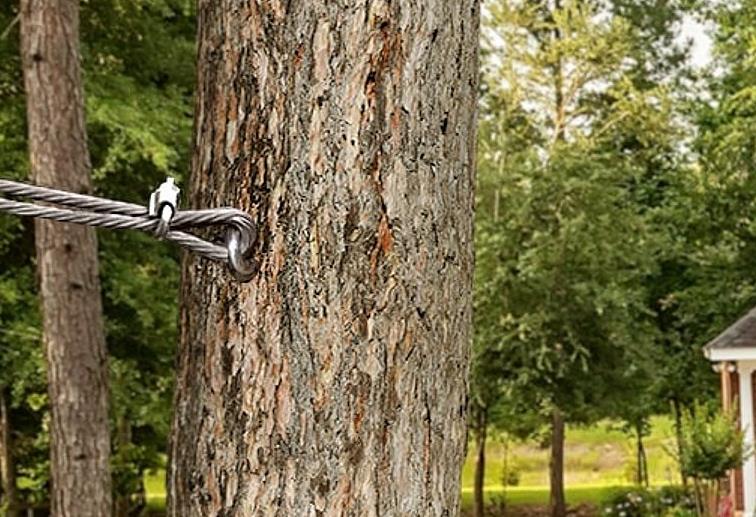
For properly installed systems, the picture from the field is reassuring. Writing in the ISA’s journal Arboriculture & Urban Forestry, arborist researcher E. Thomas Smiley describes the support system commonly used in North America, extra high strength steel cable with a manufactured dead-end grip, thimble and eyebolt, and states that such systems “seldom fail when installed and maintained in accordance with the ANSI A300 Standards” (Smiley, 2011). Where he had seen failures, he attributes them to the anchors and terminations: J-lags opening, screw eyes pulling out of the tree, or the cable termination failing where no thimble had been used.
Two conditions sit inside that sentence: installed to the standard, and maintained. Smiley’s field evaluations of installed cables looked at cable or branch failure, visible rust or other damage to the cable, and how far the tree had grown over the cable or the anchor.
That growth is normal. Trees respond to hardware by adding wood around it, and over enough years an anchor can disappear into the trunk. It’s one of the reasons a cabled tree gets looked at again rather than treated as finished. What that involves afterwards is covered in long-term care tips after tree cabling.
The pros and cons, honestly
In favor:
- It can keep a mature tree that would otherwise have to be removed, and a mature tree is not replaceable on any useful timescale.
- It targets a known weak point before a storm finds it.
- Properly installed hardware holds up well in the field.
- It’s usually far less disruptive than removing a large tree from a tight property.
Against:
- It’s a commitment, not a one-off. The hardware needs checking for the life of the tree.
- It doesn’t suit a tree with significant decay in the wood that has to hold it.
- It doesn’t remove risk, so a tree over something valuable may still need other work.
- It’s skilled work at height. The University of Maryland Extension’s position on large tree work is that it “should be performed by a licensed tree expert or certified arborist”, and that applies here: this is not a weekend project with hardware-store cable, and the wrong installation can injure the tree or fail under load.
How to tell whether your tree needs a closer look
Worth an arborist’s eye:
- A tree that divides into two or more trunks of similar size, especially with a narrow V-shaped union.
- A visible crack or seam at or below a union.
- A limb that has dropped noticeably over a season, or looks lower than it used to.
- Bark trapped in a union, or a dark seam where two stems meet.
- A tree that has already lost a large limb.
If any of that sounds like your tree, there’s a Montclair-specific guide to telling whether a tree needs cabling or bracing, and the company’s own tree cabling and bracing service page explains how the work is carried out.
Cabling and bracing at American Tree Experts
A Rombough family business for over 80 years, rated 4.9 on Google. Brian Rombough is an ISA Certified Arborist and NJ Licensed Tree Expert #494.
American Tree Experts, Inc.
47 Walnut Street, Montclair, NJ 07042
Mon to Fri 8 a.m. to 6 p.m. · Closed Sat and Sun
Serving Montclair and North Jersey


 Summer storms are hazardous for trees and neighboring properties. Consult the services of an arborist to determine whether trees on your property pose any danger to vehicles and structures in your compound. Cabling can also help in curbing excessive shedding of twigs and leaves during summer.
 If you are sensitive to grass pollen, chances are you would be sensitive to palm tree pollen as well. This is because genetically,
 When you are passionate about caring for your plants and protecting them from diseases, it can be easy to water them too much or add a lot of mulch. The general attitude is ‘more is better. However, many plants have very specific watering requirements and too much water can cause them to rot, especially from the roots.
 Smart gardening goes a long way to make sure your garden is beautiful and free of diseased plants. There are many disease-resistant varieties that you can grow. This not only makes your job easier but reduces the threat of infection almost entirely.
 Trees can also have many personal benefits as well. You can plant a tree in your house to mark moving in or celebrate the birth of a child. They can be great hobbies and tending to plants and caring for them helps people live stress-free lives. It can help improve the quality of your life when you plant fruit trees and enjoy the fruit you grew. They give you a good view outside your window that adds to the beauty of your home.
 Fertilizing the soil and trees is a must for any springtime gardening. The trees can use the extra nutrients in the soil and it will help them grow better as well. You can consider using mulch to lock in moisture in the soil after April showers to boost growth.
 A tree’s leaves tend to change color only in autumn as they prepare to fall. If your tree’s leaves are changing color in any other season then it could indicate an underlying issue. If you have an evergreen tree, leaves turning brown, red, or yellow could be signs that the tree is dying and needs immediate help.

 Cover crops are a vital part of any garden and help strengthen the structure and health of the soil. They can be produced at any time of the year and come in various shapes and sizes. If you want to improve the fertility of your garden soil, be sure to plant some cover crops this season.
 It is crucial to always be on the lookout for pests that can harm your trees whenever you are in your garden. There are a few things that you can do to protect your trees from pest infestation, and the most important one is to inspect them for any signs of trouble regularly. A few types of trees are more likely to attract pests, so it’s important to be extra vigilant if you plant these kinds of trees.