
New Jersey has already settled the question most homeowners are still asking. The state’s guidance to homeowners is that “All ash trees in NJ should be considered at high risk for EAB”, and that even where the beetle has not been found yet, ash trees are at high risk of infestation “within the next few years” (NJ Department of Agriculture). So the useful question is not whether your ash is at risk. It is whether this particular tree is worth treating, and that decision has a deadline attached to it.
The short answer: emerald ash borer is a non-native beetle whose larvae feed under the bark and kill ash trees. Infested trees “will only live an average of 3-4 years”, and “99% of ash trees will die” (NJ Department of Agriculture). Treatment exists, and the state’s line is that “It is appropriate to begin treatment of high value ash trees throughout NJ now”. The criterion it names is the value of the tree, not a stage of decline, and it tells homeowners to work with a licensed tree expert to decide whether a particular tree is a good candidate at all.
Table of Contents
What the beetle actually does
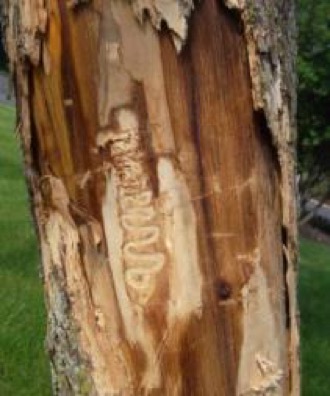
New Jersey has 24.7 million ash trees, most of them concentrated in the north-western part of the state, and ash “has been commonly planted as street trees and on private properties in many cities and towns”. That second group is the one that matters on a residential street, because a dying ash over a driveway or a sidewalk is a different problem from one in a woodlot.
Emerald ash borer itself is “a non-native insect pest that infests and kills all species of ash trees in North America”. It was first discovered in southeastern Michigan in 2002 and has since been found in 27 additional states and 2 Canadian provinces.
The damage is done by the larvae, not the adults you might see. After eggs are laid in bark crevices, the larvae burrow under the bark and feed on the cambium, the layer that moves water and nutrients through the tree. Enough of them, and the tree is effectively girdled from the inside. The adults emerge in May or early June, leaving D-shaped exit holes 3 to 4 mm across on branches and the trunk, and stay active until August.
Why you probably won’t see it first
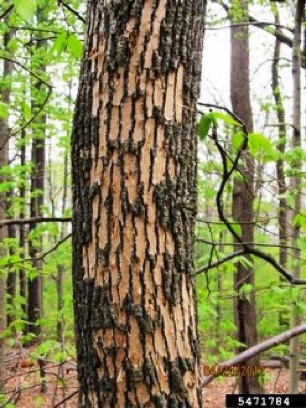
You usually can’t, which is why “my tree looks fine” isn’t reassurance. EAB “first infest the top of the tree’s crown, which makes spotting adult beetles or exit holes nearly impossible from the ground.” By the time the signs are at eye level, the infestation isn’t new.
What you can see, roughly in the order it tends to appear:
- Woodpecker activity. The state calls woodpecker activity and damage on live trees “often an initial symptom of an EAB infestation”. Birds working a live ash hard are finding something under the bark.
- Crown dieback, thinning and bare branches starting at the top.
- Epicormic branching, shoots sprouting from the trunk or lower limbs, which is the tree trying to replace a canopy it is losing.
- Bark splits, vertical splits over larval galleries.
- D-shaped exit holes lower on the trunk, which means the population has built up.
If you’re not certain the tree is even an ash, settle that first, because none of this applies to a maple or an oak. The pest goes after ash species, commonly green ash and white ash, and also white fringetree. The eggs are laid in bark crevices or under bark flaps, so the beetle’s whole cycle happens out of sight until the damage shows.
Montclair, NJ
Is that ash tree worth treating?
We can look at the crown, the bark and the signs, and tell you honestly which way it goes.
Treat or remove, and why the timing matters
New Jersey’s position on treatment is short: “It is appropriate to begin treatment of high value ash trees throughout NJ now.” The state lists the protection options as soil treatment, trunk injection and bark spray.
The words doing the work there are high value. That is a judgment about the tree and where it stands: the shade tree over the patio, the street tree that frames the house. The state doesn’t set a threshold for you, and it doesn’t leave you to guess either. It says to work with a Certified (Licensed) Tree Expert or Approved Consulting Forester “to help determine whether or not your ash trees are good candidates for a treatment program, or whether tree removal is the most appropriate response”.
On the other side of the decision, the state is equally direct:
- “Any trees determined to be a high safety risk should be removed immediately.”
- “Any actively infested trees should be cut down and chipped as soon as possible and then left on site (in the municipality).”
- “For all other ash, it is best to complete removals in the fall and winter.” The material “must be processed (chipped or de-barked) before emergence (by late April)”.
That last point is a scheduling constraint rather than a preference, and it is why an ash removal booked for February is easier to plan than one booked in May.
Doing nothing is its own choice, and the state is blunt about what it means in a yard: in the landscape, doing nothing “is really not an option, as over 99% of untreated ash trees in the landscape will eventually become infested and die from EAB.” In a wooded area it can be a reasonable decision, but only where a dying tree threatens nothing when it comes down.
Who the state says to involve
The NJ Department of Agriculture tells homeowners to “Work with a Certified (Licensed) Tree Expert or Approved Consulting Forester to help determine whether or not your ash trees are good candidates for a treatment program, or whether tree removal is the most appropriate response.”
That is a specific credential, not a generic one, and it is checkable. Brian J. Rombough is NJ Licensed Tree Expert #494 and an ISA Certified Arborist, which is exactly the qualification the state is pointing homeowners toward for this decision. American Tree Experts lists emerald ash borer treatment and deep root injection among its services, and the wider pest and disease management work is where an ash program sits.
You can also report signs of the beetle yourself. The Department of Agriculture takes reports at 609-406-6939.
Ash tree thinning at the top? Call our Montclair office before the season turns.
A dying ash is not a tree to leave standing
Ash is brittle once it dies, and it sheds limbs. A dead ash over a driveway, a fence line or a sidewalk becomes a safety question rather than a tree care one, and the state’s own first line about removal is about safety risk, not aesthetics. If the decision has gone past treatment, removal is the plan, ideally scheduled for fall or winter unless the tree is an immediate hazard.
It is also worth knowing that borers in general find weakened trees first. If an ash on your property is already stressed by compaction, root damage or drought, it is a likelier target, which is the same pattern described in tree stress and pest infestations and in our guide to detecting and preventing tree boring insects.