
Table of Contents
Why Mature Trees in Montclair Need Professional Nutrient Management
If you own a home in Montclair with a mature oak, maple, beech, or other established shade tree, you may have noticed thinning foliage, smaller leaves, slow growth, or branches that simply do not look as vigorous as they once did. The frustrating part is that these symptoms do not automatically mean your tree “needs fertilizer.” Compacted soil, disturbed roots, improper pH, drought stress, pests, and unavailable nutrients can look remarkably similar. American Tree Experts helps Montclair homeowners identify what is actually happening below ground and develop targeted nutrient management strategies rather than relying on guesswork with store-bought products.
Why Mature Trees in Montclair Can Develop Nutrient Problems
- A mature tree in a suburban yard lives in a very different environment from the same species growing naturally in a forest. In a woodland, leaves, twigs, and other organic material fall to the ground and decompose. Nutrients continually cycle back into the soil. Around Montclair homes, those leaves are often raked away. Turfgrass competes with tree roots. Driveways, sidewalks, construction, foot traffic, and landscaping can compact the soil.
Urban soils commonly have problems involving compaction, disrupted nutrient cycling, drainage, and soil chemistry. The International Society of Arboriculture also notes that mature landscape trees may grow in soils without the nutrients, proper pH, drainage, or pore space they need. That is why simply looking at a yellowing tree and deciding to “feed it” can be a costly mistake.
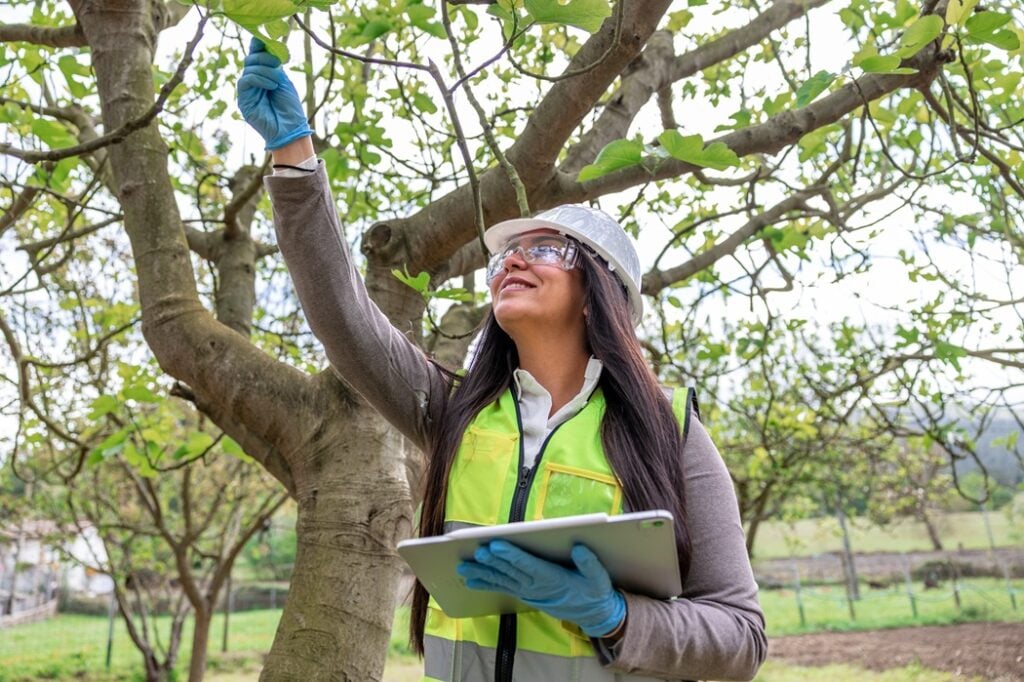
Why DIY Fertilizer Is Risky for Mature Trees
Fertilizer is not tree medicine. It is only useful when the tree actually needs the nutrients being supplied.
You Can Treat the Wrong Problem
Yellow leaves may suggest a nutrient deficiency, but similar symptoms can result from:
- Root damage or soil compaction.
- Improper watering.
- Pest or disease pressure.
- Poor drainage.
- Soil pH that prevents nutrient uptake.
- Construction-related root disturbance.
- Drought and heat stress.
A bag of general-purpose fertilizer cannot diagnose any of those problems. Professional tree care starts with the question “Why is this tree declining?”, not “Which fertilizer should we buy?”
Too Much Nitrogen Can Create Problems
- Homeowners sometimes assume that more fertilizer means more growth and therefore a healthier tree. Not necessarily. Excessive nitrogen can encourage rapid shoot growth that the tree’s root system may not be prepared to support. Applying nutrients that are already abundant also does nothing to correct the real limiting factor.
University of Maryland Extension recommends selecting fertilizer according to what the plant actually needs and avoiding unnecessary nutrients when soil testing shows that adequate levels already exist.
Soil pH May Be the Real Issue
Sometimes nutrients are already present in the soil but are chemically unavailable to the tree because the pH is unsuitable. Adding more fertilizer does not necessarily solve that. The International Society of Arboriculture recommends soil testing before fertilizing mature trees or adjusting soil pH because treatment should reflect the actual conditions within the root environment. Think of it this way: adding more food to a locked refrigerator does not help if you cannot open the door.
How Do Professionals Nourish a Mature Tree?
Professional nutrient care is much more targeted than scattering fertilizer around the trunk.
Step 1: Evaluate the Entire Tree
An arborist first looks at the tree’s overall condition. That may include leaf color and size, canopy density, twig growth, deadwood, trunk condition, root-zone changes, pest symptoms, drainage, nearby construction, and other environmental stresses. This matters because nutrient deficiency is only one possible reason for decline.
Step 2: Examine the Soil and Root Environment
- When appropriate, soil testing can help determine nutrient levels and whether pH correction is necessary. Penn State Extension describes soil testing as a tool for determining soil fertility and appropriate fertilizer or lime requirements.
The ISA similarly recommends testing the soil around mature trees before making nutrient-management decisions. The goal is simple: treat what the tree needs rather than what someone assumes it needs.
Step 3: Create a Tree-Specific Nutrient Plan
- A mature red oak does not necessarily have the same requirements as a dogwood, maple, hemlock, or ornamental shrub. American Tree Experts uses customized liquid treatments based on the needs of individual trees and shrubs.
The company’s nutrient-management approach can include soil and trunk applications designed around the plant and its growing conditions rather than a one-size-fits-all lawn fertilizer. That distinction matters for older trees that homeowners may be trying to preserve for decades.
Step 4: Address Compaction When Necessary
- Sometimes nutrients are only part of the problem. Compacted soil reduces the pore space that allows roots to receive air and water. Research and arboricultural guidance recognize soil compaction as an important limitation for trees in developed landscapes.
When soil structure is poor, an arborist may recommend addressing the root-zone environment along with nutrition rather than simply applying more fertilizer.
What Are the Signs a Mature Tree May Need Nutrient Care?
- Call an arborist when you notice persistent changes such as unusually pale or yellow foliage, smaller-than-normal leaves, thinning canopy growth, reduced twig growth, premature leaf drop, or declining overall vigor. But avoid diagnosing the tree from one symptom alone.
Imagine a large maple that has shaded a Montclair backyard for 50 years. After a patio renovation, its leaves begin looking thin and pale. Fertilizer might seem like the obvious answer. Yet the real problem could be soil compaction or root disturbance from construction. Feeding the tree without addressing that underlying stress wastes time while the tree continues declining.
How Do You Maintain Healthy Mature Trees?
Nutrient management works best as part of broader tree care. For established trees, homeowners should:
- Avoid piling mulch against the trunk.
- Protect the root zone from unnecessary soil compaction.
- Water deeply during extended dry periods when appropriate.
- Avoid damaging surface roots with landscaping equipment.
- Have unusual canopy decline, pests, or deadwood evaluated early.
- Use soil testing and professional diagnosis before routinely fertilizing.
Mature-tree care is preventive as much as corrective. Catching changes early can often give an arborist far more options.
Do All Mature Trees Need Fertilizer?
- No. This is one of the most important points for homeowners searching for mature-tree fertilizer advice. Healthy mature trees growing in favorable soil may not need supplemental fertilizer at all. A professional nutrient-management program should therefore determine whether treatment is necessary before recommending it.
That is exactly why DIY “feed every tree every spring” routines can be problematic. Professional nutrient care is not about applying more product. It is about understanding the tree, soil, roots, and surrounding environment and intervening only where intervention makes sense.
Professional Nutrient Management for Montclair Trees
A large mature tree can take decades to replace. Waiting until extensive canopy decline becomes obvious, or repeatedly experimenting with fertilizers from the garden center, can allow an underlying problem to progress.
American Tree Experts has cared for North Jersey trees since 1934. Today, the third-generation family business has an ISA Certified Arborist and New Jersey Licensed Tree Expert on staff and provides customized nutrient management alongside tree pruning and removal, pest management, and other professional tree-care services.
If an older tree on your Montclair property looks weaker than it used to, start with a diagnosis rather than a bag of fertilizer. Contact American Tree Experts at (973) 744-6091 or am*******************@***il.com to schedule an evaluation and learn whether professional nutrient management can help protect your mature trees.
Frequently Asked Questions
How do you care for a mature tree?
Protect its root zone, provide appropriate water during dry periods, use mulch correctly, monitor for pests and structural problems, and avoid unnecessary fertilizer. Periodic assessment by an arborist can identify changes before they become severe.
How do you nourish a mature tree?
Start by determining whether nutrients are actually deficient. Soil testing, tree condition, species, soil pH, and environmental stress should guide any nutrient treatment rather than applying a generic fertilizer automatically.
What is the most common mistake when caring for tree roots?
One common problem is changing the root environment through excessive soil compaction, deep excavation, added soil, or construction. Mature-tree roots require adequate oxygen, water, and uncompacted growing space.
How do you maintain healthy trees?
Healthy mature trees benefit from proper watering, appropriate mulching, protection from root damage, professional pruning when necessary, pest monitoring, and nutrient treatments based on diagnosed needs rather than routine fertilization.