American Tree Experts

How To Grow The Right Flowering Tree According To Climate?

how to grow the right flowering tree

Learn how to grow the right flowering tree in your garden

Flowers add beauty and charm to a garden. However, flowers on trees have an appeal of their own as they seem to paint the sky with colors. Most people assume flowering trees are limited to delicate climates with an extensive spring season. However, we are here to bring you species that you can grow in your own region to enjoy the beauty of colorful flowers in your garden.

What are Flowering Trees?

  • Flowering trees are any species of trees that produce flowers for reproduction. Their flowering season can last a few weeks to months even depending on the variety you choose to grow. They often are perfect as garden varieties and do not cause much issue when it comes to the pollen season either.

Top 4 Flowering Trees To Grow In Your Area

Some of the best varieties for your garden include blossoming trees. In our following guide, we mention the different soil conditions and requirements for each species so that you can pick one that best suits your climate. This will help you in nurturing your tree and making sure it has a good flowering season.

Cherry

  • Cherry trees are renowned for their beautiful flowers throughout their short-lived blossoming season. The most common variety to have are the Kwanzan and Yoshino cherry trees. They require USDA growing zones 5-9 with medium moist and well-drained soil.

These trees are medium to large in height and make perfect street trees as well if you want to plant them outside your garden. The flowers range from white to light pink. Although the plants can thrive in the sun, they need to be protected from strong winds.

Magnolia

  • Magnolias are perfect for their strong flowers that offer contrast to the thick dark-green leaves. They grow from USDA 4a-9a zones and require acidic, moist, and well-draining loam to grow in. The flowers range from purple and pink to creamy white.

They often grow up to be 33 feet tall and have lots of flowers during their flowering season. The plant should not be planted in southern exposures as they may blossom too early.

Dogwood

  • grow the right flowering treeDogwood is a flowering tree that not many people know can be planted in their gardens. Not only does the tree have beautiful flowers and berries but it has interesting branching that comes out during winter shedding.

This makes it a decorative tree all year round. It grows in USDA soils 5a-9a in medium wet but well-drained soil. The plant requires full to partial exposure to the sun. It’s a great plant to have in your garden.

Golden Chain

  • If you’re looking for a flowering tree that has more than blossoms in the traditional pink or white colors, Golden Chain is perfect for you. Its hanging yellow flowers pair perfectly with the green leaves, giving a sunny atmosphere to your garden.

The color combination livens up any area and the flower petals often scatter to decorate the grass as well. These trees grow in USDA zones 5-7 with rich moist soil that is often well-drained.

  • To grow the perfect flowering tree in your garden, it is important to maintain favorable soil conditions. At American Tree Experts, Inc. we offer the best services to keep your trees out of harm’s way. Our nutrient management services make sure your trees have the kind of soil they need to thrive. We offer services in Montclair, New Jersey. Call us at 973-744-6091 for a free quote.

9 Essential Do’s and Don’t of Summer Tree Care Plan

what is summer tree care plan

To ensure the health and vitality of your trees, here is a summer tree care plan to follow

With the temperature rising in the summer, it is important to prepare a summer tree care plan so trees can handle the heat. Below are a few do and don’ts for maintaining trees in summer.

Water your Trees Regularly

  • For effective summer tree care, it is important to water trees regularly. Watering should be done while focusing on the root zone. Watering in the morning is recommended to avoid evaporation. It will also help trees to deal with the heat during the course of the day. Newly planted trees need regular and consistent watering until root systems establish.

Don’t Overwater:

  • Excessive watering could be detrimental to trees. Excessive water in the soil leads to clogging and poor soil aeration. Check the soil for dampness before watering because if it rained recently then you don’t need to water that day. Make a schedule for watering.

Mulch:

  • Mulching helps to conserve soil moisture and stabilize temperature. The proper method of mulching is to spread it throughout the radius of the root zone. The material of choice for mulching is shredded hardwood. Mulch should be 3-4 inches thick. Mulch should be kept fresh by raking the top layer or replacing old mulch with new mulch.

Practice Fertilization:

  • Fertilizers help trees to stay healthy. Fertilization gives strength and resistance to disease and insects. Fertilization also provides important nutrients, supports tree growth, and contributes to the overall health and vitality of trees.

Carry Out Frequent Pest Inspections:

  • Warm summer weather is optimal for pest growth. Pests such as lace bugs, root rot, magnolia scale, sawflies, bagworms, Japanese beetles, wilt, and spider mites are common in summer. It is important that you find tree experts to help identify pests and kill them.

Prune Your Trees When Needed

  • Tree pruning in the summer is usually done because of the fast growth in summer. Summer’s warm weather helps in identifying defective parts of a tree. When pruning, only dead or infected branches should be removed. Pruning of broken limbs prevents the spread of disease to other parts. Summer pruning can also be done to reduce the growth of branches or trees.

Don’t Over Prune:

  • Properly pruned trees will encourage further growth of the trees. However, excessive pruning could also expose a tree to sun scalding and stress since trees rely on leaves for food. Seek the services of professionals who can discern what can be pruned or not.

Cable The Unstable Parts of The Tree

  • summer tree care planSummer storms are hazardous for trees and neighboring properties. Consult the services of an arborist to determine whether trees on your property pose any danger to vehicles and structures in your compound. Cabling can also help in curbing excessive shedding of twigs and leaves during summer.

Watch out for Signs of Heat Stress:

  • Landscaping materials such as water surfaces, structures, glass, block walls, and closed air-tight containers can intensify heat stress on trees. It is therefore important that you carefully evaluate the choice of materials used in landscaping. Some materials used for mulching like decomposed granite are heat absorbent and cause heat stress.

Summer tree care is a routine that’s valuable to adopt. Along with being refreshing and environmentally friendly, trees are a good addition to any yard as they help in raising the value of your home and property. Providing good tree care also ensures that trees have a long lifespan for you and others to enjoy in the coming years.

  • Feel free to reach out to us for a tree maintenance-related service at American Tree Expert Inc. We work tirelessly to conserve, protect and preserve your trees. Book your appointment at 973-744-6091. We are located at 47-Walnut St. Montclair New Jersey.

5 Trees To Avoid Planting If You Have A Pollen Allergy

how to protect from pollen allergy

Here is the list of trees to avoid planting in your vicinity if you have a pollen allergy

Having a pollen allergy can be very difficult for most people, especially during spring. Although pollen is mostly associated with flowers, there are many pollen-producing trees. These trees can cause sneezing and other symptoms depending on the level of exposure. Since you cannot avoid the trees that grow in your neighborhood or region, you can at least avoid planting them in your garden.

What is a Pollen Allergy?

  • Pollen allergy is a condition that is characterized by having an allergic reaction to the pollen released by flowers and trees to fertilize other members of the species. It is also commonly referred to as hay fever. It mostly occurs during the spring, but based on the region and type of trees growing in an area it can be common in any season.

Although there are certain trees you shouldn’t plant in your home in general, the list is specifically for those who suffer from bad hay fever.

Top Pollen Producing Trees That Cause Allergies

Some of the most pollen-producing trees are as follows:

Pine Trees

  • Pine trees are evergreen trees that produce a lot of pollen. They are often found in the outdoors and in residential gardens as well. Those who suffer from hayfever often react a lot to the pollen of these trees and do not prefer to be in close vicinity of them.

Mulberry Trees

  • Mulberry trees are known to be problematic for gardens due to their staining fruit and high levels of pollen. The male trees produce so much pollen that many cities have banned planting new ones. They are very hard to maintain and can be dangerous for someone with an allergy.

Oak Trees

  • Like most coniferous trees, oak trees also produce a lot of pollen. However, their pollen production is usually highest in the mornings. If you have an oak tree in your garden, you may want to wear a mask or restrict going outside in the morning.

Juniper Trees

  • There are about seventy species of juniper trees, almost all of them have high pollen output. Unlike other trees, their pollen producing season is usually in the winters. They can be harmful and irritating to residents who have an allergy, especially if these trees are present in large numbers.

Palm Trees

  • pollen allergyIf you are sensitive to grass pollen, chances are you would be sensitive to palm tree pollen as well. This is because genetically, palm trees are closely related to grasses. However, different palm trees have different pollen risks. You can easily plant royal palm trees in your garden but would have to refrain from date palm trees altogether.

What To Do If Your Garden Has A Pollen Producing Tree?

  • There are many situations in which your garden can have a pollen-producing tree without you knowing. You could move into a house where a pollen-producing tree is planted or it comes with the property etc. One of the best things you can do is opt for professional removal.

This will make sure your garden and house structure are not harmed when removing the tree. These removals ensure that you won’t have to worry about pollen allergies in your garden again.

At American Tree Experts, Inc. we offer the best services to keep your plants out of harm’s way. Our tree removal services make sure that your garden has the trees that best suit your lifestyle. Our most sought out services are pruning, bracing, pest management, and nutritional management. We offer services in Montclair, New Jersey. Call us at 973-744-6091 for a free quote.

9 Proven Ways to Prevent Diseases in Trees (Part 2)

how to prevent diseases in trees

Learn proven ways to prevent diseases in trees and keep them healthy

Making sure plants are protected from diseases is the main worry for every gardener or farmer. To most people, plants are like children and they take caring for them very seriously. It is important that you familiarize yourself with the type of diseases common in your area and how to best tackle them if the onset occurs. However, since prevention is key, we will look at some more ways to prevent diseases in plants.

Top Ways To Prevent Diseases in Plants

Some more ways to prevent diseases in plants are as follows:

Know Your Seasons and Their Requirements

  • Being mindful of the seasons is very important if you’re going to keep your plants free of diseases. Many disease-causing pests lay their eggs during the winter and they hatch in the spring.

Springtime maintenance is very important for plants and can make a big difference in their health and immunity. Similarly, as seasons change you should know when to trim your plant’s branches and leaves for better growth and flower production etc.

Balance The Garden Soil

  • The soil of your garden plays a big role in determining the nutrients that your plant uses for its growth. A lack of certain nutrients like Nitrogen, Magnesium, Potassium, etc, can cause various diseases.

You also need to make sure the soil is neither too acidic nor too basic. Depending on the type of plants you are growing and the area you live in, you can control soil conditions such as acidity and salinity.

Choose The Right Plants

  • Choosing the right plants for your garden is also very important towards ensuring they do not get infected with diseases. Some plants easily catch diseases and can transfer them to others.

In other cases, some plants strip the soil of its nutrients causing neighboring plants to face various issues like excessive yellowing or weak flowers. Therefore always choose the right plants and place complementing varieties with each other.

Find Ways To Compromise

  • Sometimes, diseases in plants are inevitable and there is nothing you can do about it. If you try to treat the cause too actively, you may ruin the rest of your plants in the process. So where you can ignore the disease simply because it ‘looks’ different but is causing no real harm to your plant’s health, you should look the other way.

Not only will this be easy on your own conscious but it can prevent you from over-tending your garden and causing distress in the plants.

Do Not Over Water or Mulch

  • prevent diseases in treesWhen you are passionate about caring for your plants and protecting them from diseases, it can be easy to water them too much or add a lot of mulch. The general attitude is ‘more is better. However, many plants have very specific watering requirements and too much water can cause them to rot, especially from the roots.

Extremely moist conditions are the perfect breeding grounds for disease. Therefore whatever you do for your plants, make sure it lies within their needs and you do not go overboard. It will save your plants and garden in the long run.

At American Tree Experts, Inc. we offer the best services to keep your plants out of harm’s way. Our pest management services make sure that your plants are protected against pests and diseases. Our most sought-after services are pruning, bracing, pest management, and nutritional management. We offer services in Montclair, New Jersey. Call us at 973-744-6091 for a free quote.

9 Proven Ways to Prevent Diseases in Plants (Part 1)

how to prevent diseases in plants

Learn how to keep your plants healthy and prevent diseases in them

Diseases can weaken plants, impact their growth, limit reproduction and even prove to be fatal in some cases. Although no one wants their plants to suffer, it takes due diligence to keep them disease-free. Some species are more susceptible to diseases than others, hence the variety of plants you chose also makes an impact. Today we look at the 9 top ways to prevent diseases in plants.

What are Plant Diseases?

  • Plant diseases are basically defined as living or non-living entities interfering with a plant’s health and body functioning. Some diseases are caused by pests whilst others are by bacteria, fungi, or even a lack of nutrients.

Top Ways To Prevent Diseases in Plants

  • One of the best ways to keep your plants safe from diseases is by preventing them from getting infected in the first place. The most helpful ways to prevent plant diseases are:

Know What Kind Of Disease You’re Dealing With

Your first line of defense is to know what kind of disease you’re most likely going to be dealing with. There are three important factors that must be present to promote plant disease:

  • A vulnerable host plant
  • A pathogen to cause the disease
  • An environment encouraging disease

This knowledge helps reduce the chances of plant infection if you remove the enabling factors for disease. For example, if you know scab disease is common where you live, consider planting a tree that does not catch that disease. Similarly, if there are pests that tend to lay their eggs in tree barks or affect smaller plants, use proper pesticides to remove them from the equation. This will help in maintaining a healthy garden in the long run.

Keep Your Garden In Top Shape

  • Making sure that your garden is in top condition is one of the best ways to prevent diseases in plants. To do this, you need to know the general conditions of the soil where you live and what are the requirements of the plants that you are growing.

If you notice diseased plants in your garden you can remove them entirely or remove the infected areas before the next season. Ideally, you should rotate your plants every growing season for the maximum prevention against diseases. The most important tip that we can give you is, when pruning or trimming, cut healthy parts off before you tend to diseased ones to avoid contamination.

Grow Disease-Resistant Varieties

  • prevent diseases in plantsSmart gardening goes a long way to make sure your garden is beautiful and free of diseased plants. There are many disease-resistant varieties that you can grow. This not only makes your job easier but reduces the threat of infection almost entirely.

However, when you consult disease-resistance in plants online, you need to understand the context varies for where you are located. It would be beneficial to talk to a local horticulture expert or someone at your local nursery. A little research goes a long way.

Use Pesticides and Fungicides Properly

  • Pesticides and fungicides do not guarantee the protection of plants against diseases. There are only a few formulas that are used as preventive measures against diseases.

In many cases, the solutions or products are applied once a plant has become diseased. You can easily consult your local supplier with how to use each product and make sure you do not use too much. Some pesticides can be harmful to health so avoid being in direct contact with them.

At American Tree Experts, Inc. we offer the best services to keep your plants out of harm’s way. Our pest management services make sure that your plants are protected against pests and diseases. Our most sought after services are pruning, bracing, pest management, and nutritional management. We offer services in Montclair, New Jersey. Call us at 973-744-6091 for a free quote.

5 Remarkable Benefits of Tree Plantation

main benefits of tree plantation

Here are 5 amazing environmental and social benefits of tree plantation

Tree plantation has become an important part of our personal and social lives. Planting a tree can benefit you and those around you. Most people feel that trees are hard to maintain and want to stay away from that trouble, but many species are easy to keep. Learn about the different benefits trees offer so you can start your plantation journey today.

Where Should You Plant Trees?

  • You can plant trees in any place as long as it’s allowed by the state or city you’re in. The safest and most beneficial place to plant a tree is in your garden since that’s your property. Tree plantations can be encouraged in schools and on community grounds as social work.

Some of the best tree varieties to plant are:

  • Evergreen trees
  • Coniferous trees
  • Decorative trees
  • Fruit trees

In some cases, you should avoid planting trees that have a lot of pollen emissions, drop fruit or shed a lot.

Benefits Of Tree Plantation

  • Everyone knows the basic benefits of planting trees. However, we take our work seriously and consider the greater impact of the deed. Some of the benefits of tree plantation are:

Social Benefits

  • Trees have many social benefits such as making life nicer. It improves the quality of life for everyone by having a ‘calming effect’ on their nerves. Societies with trees have lower rates of mental health issues and faster healing amongst the sick. Trees can also be planted as memorials or markers for specific events in a town’s history or achievements.

Environmental Benefits

  • The environmental benefits of tree plantations are one of the most well-documented ones. Trees help improve the quality of air by producing more oxygen and filtering out carbon dioxide. They can grip onto the soil to prevent erosion during flooding. Trees play a big part in regulating the heat of any area and controlling moisture levels in the air.

Communal Benefits

  • There are communal benefits to trees planted on your property as well. It can help make the neighborhood look more friendly or give your neighbors a good view. Trees planted alongside streets can reduce the speed of traffic and encourage drivers to drive more carefully. It creates shade for children to rest under when they plat outside and become the perfect place to built tree houses or swings.

Personal Benefits

  • benefits of tree plantationTrees can also have many personal benefits as well. You can plant a tree in your house to mark moving in or celebrate the birth of a child. They can be great hobbies and tending to plants and caring for them helps people live stress-free lives. It can help improve the quality of your life when you plant fruit trees and enjoy the fruit you grew. They give you a good view outside your window that adds to the beauty of your home.

Economic Benefits

  • The economic benefits of trees are something that most people aren’t aware of. When they hear economic benefits they think it wouldn’t affect them directly but they’re wrong. Trees help reduce household costs on heating and cooling. They also increase the value of the property as it is seen as more attractive.

At American Tree Experts, Inc. we offer the best services to keep your trees out of harm’s way. Our nutrient management services ensure your trees have all the nutrition they need to grow strong and healthy. Our most sought out services are pruning, bracing, pest management, and nutritional management. We offer services in Montclair, New Jersey. Call us at 973-744-6091 for a free quote.

5 Spring Tree Care Tips For Healthy Trees

spring tree care tips

Here is a list of the top 5 spring tree care tips for healthy trees

Spring is a time when gardeners are always on edge to make the most out of their trees. The shift in temperature promotes the growth of new branches and leaves and the blooming of flowers. This is the perfect time to exercise care and help your tree grow healthier.

Why Is Spring So Important To Trees?

  • Spring is important for trees because it gives them the chance to recover from the harsh winters. It is a time of accelerated growth and healing for many trees and is vital for their reproduction as well. You must tend to the needs of your trees during this period as it will influence how strong they grow till the next winter.

Three Phases Of Spring

  • Many gardeners divide spring into three phases. This makes it easier to manage the needs of their tree whilst keeping track of optimum timing to exercise certain tree-care practices. These phases are:

Early Spring

  • Early spring is when the temperatures are changing from cold to moderately warmer. Snow starts to melt and new leaves and stems start to sprout. This is also the time when many pests come out of hiding, and their eggs start to hatch.

Pre-Bloom Period

  • The pre-bloom period is when your tree is consuming the most nutrients from the soil to create flowers to blossom. The prerequisite of this phase is that the dead branches and leaves of the tree should be removed, and the soil should be replenished so there are enough nutrients.

During Springtime

  • This is when spring is in full swing and there is the growth of trees, flowers, and fruit everywhere. You can ideally plant new trees during this period and line existing ones with mulch to preserve moisture in the soil.

Spring Care Tips For Healthy Trees

  • Some of the best things you can do to care for your trees during springtime are as follows:

Inspect Your Trees

  • The first and most important thing that you need to do is inspect your trees. During the winter, many pests may lay their eggs on the bark of trees and inside cracks in the trunks. These eggs will hatch and infest the tree in spring if you do not identify them in time.

Consider Pruning

  • Since spring is the time for growth and rejuvenation, pruning is perfect for this season. Try and cut off dead or dying branches so that new ones can grow in their place. Always consider a proper pruning pattern so that your tree’s structure is not harmed.

Get Rid of Weeds

  • Weeds take up nutrients from the soil that trees need during spring for flowering and growth. Weeding the garden and the area around the trees helps remove extra plants exhausting the soil of its nutritional value. It is especially recommended to weed out your garden during spring.

Use Fertilizer

  • spring tree careFertilizing the soil and trees is a must for any springtime gardening. The trees can use the extra nutrients in the soil and it will help them grow better as well. You can consider using mulch to lock in moisture in the soil after April showers to boost growth.

Water Your Trees

  • Although spring may seem like the time when trees don’t need much attention, you need to water them regularly. This is because trees are using up a lot of the soil’s moisture to grow new leaves, branches, and flowers.

At American Tree Experts, Inc. we offer the best services to keep your trees out of harm’s way. Our pest management services make sure that your trees are protected against pests and diseases in the springtime. Our most sought out services are pruning, bracing, pest management, and nutritional management. We offer services in Montclair, New Jersey. Call us at 973-744-6091 for a free quote.

Top 5 Signs of A Diseased Tree

top signs of a diseased tree

Here is a list of top signs of a diseased tree and how to solve the problem

Trees are susceptible to diseases just like any other living organism. However, the signs of diseases in trees are hard to detect when you are not familiar with the basics of tree health. To the regular person, it may look like your tree is going through some changes, but this can be very dangerous.

Although there are ways to tackle tree diseases at home, a professional opinion is always recommended. You need to know the signs of tree disease so you can get your tree help in time and save it from any permanent damage.

What Are Tree Diseases?

  • Tree diseases are conditions that affect the tree, its longevity, and reproductive abilities. These can be caused by a lack of nutrients as well as by pests and bacteria. They are commonly prevalent in springtime and winters are the period when most pests lay their eggs. Knowing the timing to check your tree for diseases is also a very important aspect of tree care.

What Are Some Of The Most Common Tree Diseases

Some of the most common tree diseases are:

  • Anthracnose
  • Leaf Spots
  • Rust
  • Powdery Mildew
  • Tar Spots
  • Leaf Blisters
  • Canker Diseases
  • Apple Scabs

Signs Of A Diseased Tree

  • Although a professional is better at diagnosing tree diseases, you can learn to be on the lookout for certain signs as well. Some of the most common signs of a diseased tree are:

The Tree Bark Is Changing

  • The bark of a tree tells many things about its health. If you notice fungus growing on the tree, or small lumps on the bark then the tree is catching a disease. Similarly, you should be on the lookout for white or black spots on the bark. For subtle signs such as peeling or chipping bark, you can ask a professional for a second opinion.

The Foilage Is Reducing

  • Healthy trees are almost always green and full of leaves. The foliage of your tree gradually reduces towards autumn and sometimes sheds completely in winter. However, a significant reduction in foliage during spring or summer is a clear indicator of a diseased tree.

The Trunk Is Cracking

  • A healthy tree’s trunk is strong and does not easily crack. Cracking of the trunk could indicate a nutrient deficiency or the onset of a disease. Harmless cracks are often only on the surface and do not run deep. If the cracks on your tree’s trunk run deeper than the bark, then your tree may be compromised.

Leaves Are Starting to Discolor

  • signs of a diseased treeA tree’s leaves tend to change color only in autumn as they prepare to fall. If your tree’s leaves are changing color in any other season then it could indicate an underlying issue. If you have an evergreen tree, leaves turning brown, red, or yellow could be signs that the tree is dying and needs immediate help.

You Can See Pests

  • Sometimes you can see a fine powder on the bark of your trees, or the presence of pests as they have eaten the leaves or bark. This is the most obvious indicator that your tree is suffering from some sort of parasitic disease or has a pest infestation. At this stage, it is important to have a professional look into the matter.

At American Tree Experts, Inc. we offer the best services to keep your trees out of harm’s way. Our pest management services make sure that your trees are protected against pests and diseases. Our most sought out services are pruning, bracing, pest management, and nutritional management. We offer services in Montclair, New Jersey. Call us at 973-744-6091 for a free quote.

Tree Cabling and Bracing: What They Do, When a Tree Needs Them, and What They Can’t Fix

Arborist installing a steel support cable high in a tree

The risk usually shows up in one place: the spot where a big tree divides into two trunks. If that union starts to split, the next heavy storm can take half the tree down, often onto whatever is underneath it. Cabling and bracing are the usual answer to that problem, and they’re the reason a tree that looks doomed can sometimes stay. But they’re support, not repair, and they aren’t right for every tree.

The short answer: cabling and bracing are support systems installed in a tree to limit how much a weak part can move. Cabling uses flexible cable high in the canopy to limit movement between two leaders or heavy limbs. Bracing uses rigid rods through a weak union or a split to hold the parts together. Neither one repairs decay, and neither makes a tree safe. They reduce the chance of one specific failure in a tree that is otherwise worth keeping, and they commit the owner to having that hardware checked for as long as the tree stands.

What the two systems are

The International Society of Arboriculture’s best practice guide for this work covers cables, braces, guys and props, and describes them as hardware that can “effectively limit the movement of branches, leaders, or entire trees” (ISA, Best Management Practices: Tree Support Systems). That phrase is the useful part: these systems limit movement. They don’t add strength to wood that has already failed.

  • Cabling is the flexible half. Cable is installed high in the crown, between limbs or leaders, so that the two parts can’t move independently in a way that levers the union apart.
  • Bracing is the rigid half. Rods are installed through the weak union or the split itself, holding both sides together.

The two are often used on the same tree, since a split union usually needs both the rods across the crack and the cable above it.

The guide is a companion to the ANSI A300 standards, the written standards for tree care work in the United States. That matters for a practical reason: the research on these systems is based on hardware installed to that standard.

Why weak unions fail in the first place

Most cabling work traces back to how the tree grew, usually long before anyone thought about it.

A tree with two trunks of roughly equal size, called codominant stems or a double leader, is weaker where they meet than a tree with one central trunk and smaller side branches. The University of Maryland Extension’s guidance on pruning is blunt about it: if a young tree has co-dominant stems, remove one “to avoid structural weakness” (University of Maryland Extension).

The other half of the problem is included bark. When two stems grow tightly together, bark gets trapped inside the union instead of wood knitting across it. The same Extension guidance describes how the bark becomes enclosed in the crotch, “which leads to weakness and branch failure or dieback”. A union with included bark can look completely solid from the ground and still be the weakest point in the tree.

On a young tree, the fix is pruning. On a mature tree, removing one of two 60-foot trunks isn’t pruning any more, and that’s where support systems come in.

Montclair, NJ

Worried about a split or a double trunk?

A look at the tree is the only way to tell whether support is realistic.

Request a site visit

When a tree is a candidate, and when it isn’t

A tree is a candidate when the defect is specific, the wood that has to hold the hardware is sound, and the rest of the tree is worth keeping. So the decision isn’t really about the crack. It’s about everything around it.

  • Is the rest of the tree worth keeping? Support hardware is a long-term investment in one tree. A tree in decline, or one that would need large amounts of deadwood removed every year anyway, is a poor candidate.
  • How much decay is in the wood that has to hold the hardware? Cables and rods anchor into wood. Wood that is soft or hollow can’t be relied on to hold them.
  • How big is the defect? A hairline crack at a union and a trunk split halfway to the ground are different problems with different odds.
  • What’s underneath? A tree over a driveway, a house or a play area is judged differently from the same tree in open lawn, because the consequence of failure is different.
  • Can it be reached and maintained? Hardware that can’t be inspected isn’t much use.

A good arborist will sometimes tell you the honest answer is removal. That’s not a sales position, it’s the same assessment arriving at a different conclusion: when the wood that would carry the hardware isn’t sound, support just moves the failure somewhere else.

What cabling and bracing can’t do

  • They don’t repair the defect. A split union with a brace through it is still a split union. The hardware limits movement so the tree can keep standing and, over time, add wood of its own.
  • They don’t make a tree safe. They reduce the likelihood of one specific failure. Trees are living structures in weather, and nothing installed in one makes it risk-free.
  • They don’t replace pruning. Reducing the weight and sail area on an over-extended limb is often part of the same job, and sometimes it’s the better answer on its own. There’s a separate article on cabling versus pruning for Montclair trees.
  • They don’t end the conversation. The hardware stays in the tree, and the tree grows around it.

Not sure whether a tree can be saved or should come down? Call our Montclair office.

(973) 744-6091

Does it actually hold?
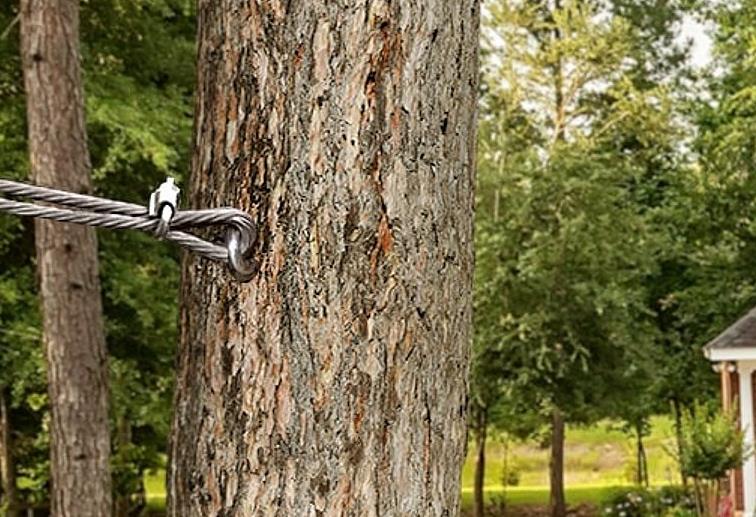
Steel support cable anchored into a tree trunk with an eyebolt and thimble

For properly installed systems, the picture from the field is reassuring. Writing in the ISA’s journal Arboriculture & Urban Forestry, arborist researcher E. Thomas Smiley describes the support system commonly used in North America, extra high strength steel cable with a manufactured dead-end grip, thimble and eyebolt, and states that such systems “seldom fail when installed and maintained in accordance with the ANSI A300 Standards” (Smiley, 2011). Where he had seen failures, he attributes them to the anchors and terminations: J-lags opening, screw eyes pulling out of the tree, or the cable termination failing where no thimble had been used.

Two conditions sit inside that sentence: installed to the standard, and maintained. Smiley’s field evaluations of installed cables looked at cable or branch failure, visible rust or other damage to the cable, and how far the tree had grown over the cable or the anchor.

That growth is normal. Trees respond to hardware by adding wood around it, and over enough years an anchor can disappear into the trunk. It’s one of the reasons a cabled tree gets looked at again rather than treated as finished. What that involves afterwards is covered in long-term care tips after tree cabling.

The pros and cons, honestly

In favor:

  • It can keep a mature tree that would otherwise have to be removed, and a mature tree is not replaceable on any useful timescale.
  • It targets a known weak point before a storm finds it.
  • Properly installed hardware holds up well in the field.
  • It’s usually far less disruptive than removing a large tree from a tight property.

Against:

  • It’s a commitment, not a one-off. The hardware needs checking for the life of the tree.
  • It doesn’t suit a tree with significant decay in the wood that has to hold it.
  • It doesn’t remove risk, so a tree over something valuable may still need other work.
  • It’s skilled work at height. The University of Maryland Extension’s position on large tree work is that it “should be performed by a licensed tree expert or certified arborist”, and that applies here: this is not a weekend project with hardware-store cable, and the wrong installation can injure the tree or fail under load.

How to tell whether your tree needs a closer look

Worth an arborist’s eye:

  • A tree that divides into two or more trunks of similar size, especially with a narrow V-shaped union.
  • A visible crack or seam at or below a union.
  • A limb that has dropped noticeably over a season, or looks lower than it used to.
  • Bark trapped in a union, or a dark seam where two stems meet.
  • A tree that has already lost a large limb.

If any of that sounds like your tree, there’s a Montclair-specific guide to telling whether a tree needs cabling or bracing, and the company’s own tree cabling and bracing service page explains how the work is carried out.

Cabling and bracing at American Tree Experts

A Rombough family business for over 80 years, rated 4.9 on Google. Brian Rombough is an ISA Certified Arborist and NJ Licensed Tree Expert #494.

American Tree Experts, Inc.

47 Walnut Street, Montclair, NJ 07042

Mon to Fri 8 a.m. to 6 p.m. · Closed Sat and Sun

Serving Montclair and North Jersey

7 Ways to Improve Fertility of Garden Soil

7 ways to improve fertility of garden soil

Learn 7 easy methods to improve the fertility of garden soil naturally

Soil fertility is an essential factor to consider when gardening. Fertile soil will produce healthy plants, flowers, and vegetables. Although organic fertilizers have many benefits, you can improve soil fertility naturally as well. There are several ways to improve the fertility of your garden soil. Here are the top seven ways to improve garden soil.

Add Compost

  • Adding compost is one of the best ways to improve garden soil and enhance fertility. By adding compost to your garden, you provide your plants with essential nutrients, improve your soil structure, and increase the water-holding capacity of your soil. Compost also helps to suppress plant diseases and pests, and it increases the rate at which your soil warms up in the springtime.

Compost is decomposed organic matter that enables the soil to maintain a neutral pH level and protects your vegetation from many garden diseases.

Conduct A Soil Test

  • A soil test is the best way to determine the fertility of your garden soil and what, if any, amendments are needed. Soil amendments can include compost, manure, or fertilizers.

The best time to conduct a soil test is in the late fall or early winter before planting begins. This will give you enough time to make any necessary amendments before planting in the spring. You can also test your soil throughout the gardening season to see if additional modifications are needed.

Mulch The Soil

  • One way to improve the fertility of your garden is by mulching the soil. Mulching is the process of adding a layer of material to the soil’s surface to protect it from erosion, improve moisture retention, and enhance the fertility of the soil. You can use various materials for mulching, including compost, bark chips, straw, or leaves.

Prevent Compaction

  • Soil compaction occurs when the soil particles are pressed together tightly, reducing the air spaces in the soil. This makes it more difficult for water and roots to move through the soil and can lead to a decrease in plant growth. Soil compaction can be prevented by using organic matter, such as compost, to improve the soil structure.

Clay soil compacts a lot quicker and requires a fair bit of organic matter to keep the natural balance in the soil’s structure.

Rotate Plants

  • When you rotate your plants, you are improving the fertility of your garden soil. By rotating your crops, you allow each type of crop to feed off different nutrients in the soil. This also helps prevent any kind of crop from depleting the soil of any particular nutrient.

Produce Cover Crops

  • improve fertility of garden soilCover crops are a vital part of any garden and help strengthen the structure and health of the soil. They can be produced at any time of the year and come in various shapes and sizes. If you want to improve the fertility of your garden soil, be sure to plant some cover crops this season.

Add Animal Manure

  • Adding aged animal manure is one of the easiest ways to improve garden soil fertility. The manure will help add nutrients and organic matter to the soil, which will help improve the overall health of your plants. Use balanced manure, such as cow manure, rather than poultry manure, which is high in nitrogen and can be harmful to plants in large quantities.

At American Tree Experts, Inc. we offer the best services to keep your plants out of harm’s way. Our Nutrient Management for Gardens service makes sure that your garden soil is always nutritional and ready to support growing plants. Our most sought out services are pruning, bracing, pest management, and nutritional management. We offer services in Montclair, New Jersey. Call us at 973-744-6091 for a free quote.