
Table of Contents
Understanding Tree Bark Damage: Insects, Disease, or Other Causes?
If you’re a homeowner in Montclair or nearby North Jersey towns who’s noticed cracks, peeling, holes, or sticky sap on a tree in your yard, this article is for you. Bark damage is one of those things that’s easy to ignore, until a healthy-looking tree suddenly declines or becomes unsafe. The frustrating part? Many bark problems look similar at first glance, but the cause (and the fix) can be completely different. That’s where American Tree Experts comes in: with decades of hands-on experience, ISA-certified arborists, and local knowledge of North Jersey pests and weather patterns, they help homeowners figure out what’s really going on, before a small issue turns into a costly removal.
Why Tree Bark Damage Deserves Your Attention
Bark isn’t just “tree skin.” It protects the tree’s vascular system, regulates moisture, and helps defend against insects and disease. When bark is compromised, trees become vulnerable, fast. In Montclair, we see this happen a lot after hot summers, sudden cold snaps, or heavy pest seasons. Too many homeowners spend thousands trying to “save” a tree after the damage has already progressed beyond repair. Early identification changes everything.
Common Causes of Tree Bark Damage (and How to Spot Them)
Insect damage: borers, beetles, and hidden pests
If you see small, round, or D-shaped holes, fine sawdust-like material (called frass) collecting in bark crevices, or sap oozing down the trunk, insects are often the culprit. Borers and beetles tunnel beneath the bark, disrupting the tree’s ability to move water and nutrients.
What to look for:
- Tiny exit holes in the bark.
- Frass at the base of the tree.
- Sticky sap streaks.
- Thinning canopy or dieback at the top.
In North Jersey, stressed trees, especially ash and hemlock, are prime targets. Once borers are established, treatment timing is critical.
Disease and Fungal Infections: When Bark Starts to Rot
Tree diseases often present as cankers, discolored patches, or peeling bark that exposes soft or spongy wood beneath. You might also notice mushrooms or shelf-like growths (called conks) on the trunk.
Red flags include:
- Cracked or sunken areas in the bark.
- Dark staining or unusual coloration.
- Bark pulling away from the trunk.
- Fungal growths near damaged areas.
According to the USDA Forest Service, fungal infections often take advantage of trees already weakened by stress or injury, another reason early diagnosis matters.
Environmental and Physical Damage: Not Always Pests or Disease
Not all bark damage is biological. Some of the most common issues we see around Montclair are weather- and equipment-related.
Sunscald
Vertical cracks on the south or southwest side of a tree are a classic sign of sunscald. Winter sun warms the bark during the day, then temperatures drop rapidly at night, killing the tissue.
Frost cracks
These are long vertical splits caused by sudden temperature drops, often after mild winter days followed by deep freezes.
Mechanical injury
Lawnmowers, string trimmers, and even snowblowers can nick or strip bark near the base. These wounds may appear minor, but they create openings for insects and disease.
Natural Bark Shedding: When It’s Actually Normal
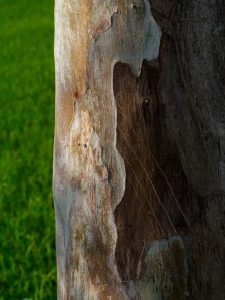
Some trees, like sycamores, river birch, and mature pines, naturally shed bark as they grow. This peeling tends to be even and seasonal, without soft wood, holes, or decay underneath. If the tree otherwise looks healthy, this may be nothing to worry about.
How to Figure Out What’s Really Causing the Damage
Before jumping to treatment, take a step back and assess:
- Inspect the site
Has there been drought, construction, soil compaction, or lawn damage nearby? - Examine the pattern
Is the damage localized or spread across the tree? Is it on one side or on all sides? - Look for secondary symptoms
Dieback, sparse leaves, or a thinning canopy often indicate underlying issues.
If bark is peeling extensively, rot is visible, or the canopy is declining, it’s time to bring in a professional.
Can A Damaged Tree Bark be Treated?
Sometimes, yes, and sometimes, no. Treatments depend entirely on the cause:
- Insect issues may require targeted pest management or trunk injections.
- Disease may call for pruning, nutrient support, or monitoring.
- Environmental damage often benefits from corrective care and prevention strategies.
What doesn’t help? Wound paint, DIY sprays, or ignoring the problem. These often make things worse.
When to Call an Arborist (and Why it Saves Money)
If you’re unsure whether bark damage is cosmetic or dangerous, that uncertainty alone is a reason to call. An ISA Certified Arborist can tell you:
- Whether the damage is primary or secondary.
- If the tree can recover or poses a safety risk.
- What treatment timeline actually makes sense?
American Tree Experts has been doing this since 1934, and their crews are known locally for spotting issues homeowners can’t see from the ground.
Final Thoughts, and a Logical Next Step
Tree bark damage is rarely “just cosmetic.” In Montclair’s climate, it’s often a signal of stress, pests, or disease. The earlier you understand the cause, the more options you have. If this feels overwhelming, you don’t have to figure it out alone. Call American Tree Experts at (973) 744-6091 or email am*******************@***il.com to schedule an evaluation. Sometimes, one expert look can save a tree, and a whole lot of stress.