
Plenty of homeowners with a huge tree behind the house assume the same thing: a tree that big needs a crane, and if a crane can’t get into the yard, the tree is stuck there. It’s an understandable worry when the tree is dead, leaning toward the roof, and surrounded by fences, garages and the neighbors’ yards. It’s also not quite right. A crane is the best tool for some removals and simply not an option for others, and an experienced crew plans the job around whichever one it is.
The short answer: a crane is used when a tree is too large, too heavy or too close to a house to be cut down and lowered safely by hand, and when there’s a place to set the crane up within reach of the tree. When there isn’t, a big tree can still come down safely. A climber takes it apart from the top down, lowering limbs and short sections of trunk with ropes, sometimes working from a compact lift that can be driven into a backyard where a crane can’t go.
Table of Contents
When a crane is the right tool
A crane lets a crew lift large pieces of a tree up and away instead of cutting them and lowering them down the tree. That matters most when there’s nowhere safe for heavy wood to land.
Arborists usually start thinking about a crane when several of these are true:
- The tree is very large. Big limbs and trunk sections are heavy, and lowering them on ropes puts a lot of load on the tree and the rigging.
- It’s close to something that can’t be hit. A house, a garage, a pool or power lines leave no room to drop wood.
- The tree is unsound. A tree that’s dead, cracked or badly decayed may not be safe to climb or to rig heavy pieces from.
- The crane can get close enough. This is the one that decides everything else. A crane needs a firm, level spot to set up, and the farther it has to reach, the less weight it can lift. A crane parked on the street may not be able to lift a heavy trunk section from the back corner of a deep lot.
That last point is why “do we need a crane?” is hard to answer without seeing the site. It depends on where the tree is, not just how big it is.
Why a crane sometimes can’t get to the tree
In older neighborhoods with mature trees, the biggest trees are often behind the house, and the house is in the way. Common reasons a crane can’t be used:
- The backyard is landlocked, with houses, garages or fences on every side and no driveway leading back to it.
- There’s no firm ground close enough to set up. Soft lawn, a slope, a septic area or a retaining wall can rule out a spot.
- Water is in the way. A creek or a wet area between the street and the tree changes where equipment can go.
- Overhead wires cross the only open path.
- The distance from the nearest setup spot is too great for the crane to lift the pieces the tree would have to be cut into.
None of these means the tree has to stay. They mean the removal gets planned a different way.
Montclair, NJ
Big tree and no easy way to reach it?
We can look at the site and explain how the tree would come down.
How a big tree comes down without a crane
Climbing and lowering it in pieces
The traditional method is still the backbone of tree work. A climber ascends the tree, secures lines above the work, and removes it from the top down. Limbs are cut and lowered to the ground crew on ropes instead of being dropped, and the trunk is taken down in short sections rather than felled in one piece. Short sections weigh less, so they can be controlled on the way down and land where the crew wants them.
It’s slower than a crane. Every limb is its own small job: where it’s tied, where it’s cut, how it swings, and where it lands. That time is the price of doing it safely in a tight yard.
Compact lifts that fit through a yard
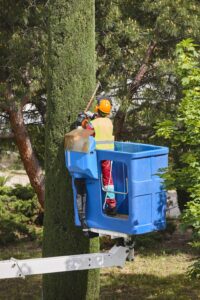
Some lifts are built with a small footprint so they can travel through a side yard or gate and still reach high into a tree. Working from a lift, the crew can cut the trunk from alongside it rather than from a climbing line, and still take it down in small, controlled sections. Whether a lift can be used depends on the width of the access, the ground it has to cross, and how close it can get to the trunk.
Why the tree’s condition changes the plan
A living tree and a dead one don’t behave the same way. As a dead tree dries and decays, its wood can become brittle, and it gets harder to judge how much weight a limb will hold or how a cut section will break. That affects whether a climber can safely tie in, where lines can be anchored, and how big each piece can be.
It’s also why a dead tree near a house shouldn’t wait. If a tree looks lifeless but it’s the dormant season, it’s worth learning how to tell whether a tree is dead or just dormant before you call.
Dead tree close to the house? Call our Montclair office to have it looked at.
Two removals, two different answers
American Tree Experts customers have described both kinds of job in their Google reviews.
A crane, a creek and several neighbors
One customer had two ash trees in difficult spots. Taking them down meant working with multiple neighbors, bringing in what the customer called “a giant crane,” and dealing with a creek and some very large trees. What stood out to them wasn’t the machine. It was the coordination, and that the crew cleaned up all the debris afterward.
A 100-foot oak in a landlocked backyard
Another customer’s roughly 100-year-old, 100-foot oak had died, close enough to the house to be a real hazard. A tree that size near a house would normally call for a crane, but the backyard was landlocked and a crane couldn’t be positioned close enough.
So the removal was planned around a climber. Brian Rombough, one of the owners, directed the crew from up in the tree rather than from the ground, taking his time to assess each large limb and then the trunk. A lift with a small footprint but a tall reach was maneuvered into the backyard, which made it possible to cut the tall trunk into the small sections the job needed to be done safely. The oak had apparently died of old age, and the trunk was solid wood. The crew even loaded the trunk sections onto a carpenter friend’s trailer so the customer could have them cut into timbers.
Same kind of problem, two very different setups. In both cases the method came from the site, not from a default.
Before an arborist comes to look at the tree
A little information makes the first visit more useful:
- Know the access. Where’s the widest path from the street to the tree? Is there a gate, a driveway, a side yard?
- Think about the neighbors. If equipment might need to cross or park on a neighbor’s property, it helps to have that conversation early.
- Check whether a permit applies. Find out whether Montclair requires a permit for your tree before work is scheduled.
- Decide about the stump. Taking the tree down is one decision, and the stump is another. It’s worth knowing what happens to the roots after a tree is removed before the crew arrives.
If you need to have a large tree removed near your house and aren’t sure a crane can reach it, the answer comes from looking at the site: the access, the ground, and the condition of the tree.