
Table of Contents
Signs Your Montclair Tree Needs Cabling or Bracing Support
If you’re a Montclair homeowner worried about whether that large maple or oak in your yard is becoming unstable, this article is for you. Many residents deal with the stress of cracked trunks, sagging limbs, or branches that look like they might fail during the next nor’easter, and figuring out what’s dangerous versus what’s normal growth can feel overwhelming. This is where American Tree Experts comes in: with nearly a century of experience and ISA-Certified Arborists on staff, they help homeowners identify structural issues early and use proper cabling or bracing to keep trees (and your property) safe.
Why Tree Cabling and Bracing Matter in Montclair
Montclair’s tree canopy is beautiful, but it’s also old; many properties have mature maples, sycamores, and oaks that have been standing for generations. Between heavy snow loads, unpredictable storms, and dense neighborhoods where homes sit close together, a compromised tree can quickly turn into a major hazard.
Most dangerous limbs don’t give a dramatic warning. The signs are often subtle, especially when decay or splitting starts high in the canopy. Too many homeowners ignore early clues, only to face expensive emergency removals after a storm.
Cabling and bracing exist for one reason: to stabilize weak or failing branches before they break.
Clear Signs Your Tree May Need Cabling or Bracing
1. Cracked or Split Trunk
- If you notice a visible split in a trunk or major limb, that’s one of the clearest indicators. In Montclair’s older neighborhoods, this often happens where two large trunks form a narrow V-shape, a naturally weak union. Bracing rods are commonly used to hold these sections together.
2. Weak or V-Shaped Branch Attachments
Two branches or stems growing tightly together create compression and form what arborists call a “weak union.” If you see bark being squeezed or a narrow V angle, that junction may fail in snow or wind.
3. Heavy or Overextended Limbs
- Long, stretched-out limbs, common on old silver maples, often sag under their own weight. If a branch looks heavy, droopy, or like it’s “pulling away,” cabling may redistribute that load before it snaps.
4. Storm Damage or Past Wind Stress
Montclair’s thunderstorms and winter nor’easters often reveal hidden structural weaknesses. Even if a limb didn’t break, a storm can loosen attachments, twist branches, or create hairline cracks. These often worsen months later.
5. Creaking or Groaning Sounds in Wind
- This one surprises people, but unusual noises in windy weather can mean internal fibers are under stress. A branch that “pops” or “groans” is often moving more than it should.
6. Leaning or Unbalanced Canopy
A tree leaning toward a driveway, garage, or neighbor’s house isn’t automatically dangerous, but paired with other symptoms, it signals instability. An uneven canopy with thinning or dead branches can indicate internal decay.
7. Cavities, Decay, or Hollow Spots
- Rot at the base of a limb or within the trunk weakens the wood, increasing the likelihood of collapse. Even cavities you can’t see from the ground may exist higher in the canopy, one reason professional inspection is essential.
How to Inspect Your Tree Safely (Without Climbing It)
You don’t need special equipment to spot the early warning signs. A simple monthly walkthrough of your yard can catch issues before they escalate.
Look for:
- New cracks in bark.
- Branches pulling away from the trunk.
- Mushrooms or decay at attachment points
- Limbs sagging more than usual
- Deadwood accumulating in the canopy
- Tight V-shaped crotches
Homeowners can only see so much from the ground. Many structural problems hide 30 to 60 feet up, where only a trained arborist using climbing or bucket equipment can inspect safely.
Cabling vs. Bracing: What’s the Difference?
Cabling (Flexible Support)
Used to stabilize branches, not trunks. Cabling involves installing steel cables between major limbs to limit movement during storms and reduce stress on the limbs.
Best for:
- Overextended limbs
- Weak branch unions
- Protecting large, healthy trees from limb failure
Bracing (Rigid Support)
Used when a trunk or major limb is split, cracked, or at risk of separation. Bracing uses threaded steel rods drilled through the tree to hold it together.
Best for:
- Split trunks
- Rot or cavities compromising the trunk structure
- Severe storm damage
Cabling and bracing are often used together; American Tree Experts installs both, depending on the tree’s needs.
How a Certified Arborist Decides Whether Cabling Is Needed
This is where professional evaluation matters. An ISA Certified Arborist will look at:
- Species-specific structural tendencies
- The tree’s age and overall health
- Stress history (snow loads, storms, pruning)
- Size and angle of limb attachments
- Internal decay or cavities
- Root structure and soil condition
Montclair’s dense property lines and older tree species mean arborists often recommend proactive cabling to prevent future failures rather than responding after cracks appear.
Commonly Asked Questions
When should you cable a tree?
Cable a tree when it has weak branch unions, overextended limbs, or structural issues that could cause failure in storms. Arborists often install cables preventively to protect mature trees from breaking under snow or wind loads.
How much does it cost to cable a tree?
Costs vary widely based on tree size, number of cables, and canopy height. Most homeowners in Montclair can expect to pay anywhere from a few hundred dollars to several hundred dollars for complex setups. A quick on-site evaluation gives the most accurate estimate.
Is cabling a tree worth it?
Yes, preserves mature trees, prevents dangerous limb failures, and saves thousands in potential property damage. It’s a cost-effective alternative to removal when the tree is otherwise healthy.
How long does tree cabling last?
High-quality steel cabling systems typically last 10–15 years, but they should be inspected every few years by an arborist to ensure they remain secure and effective.
When to Call a Professional (And Why It Matters)
If any of the earlier warning signs show up, especially splits, sagging limbs, cracks, or heavy lean, it’s time for a professional assessment. Cabling and bracing require precise placement, proper tensioning, and specialized hardware. Incorrect installations can fail when you need them most.
With American Tree Experts, you’re getting:
- A New Jersey Licensed Tree Expert
- ISA-Certified Arborists
- 90+ years of family-run service
- Detailed structural assessments
- Safety-first cabling and bracing installations
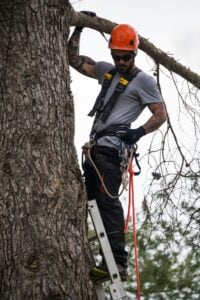
They don’t make decisions from the ground, they climb, inspect, and diagnose the issues that most homeowners can’t see.
If you’re concerned about the stability of a tree on your property, whether it’s a small crack or a limb that seems heavier than it used to, don’t wait for the next storm to test it. Contact American Tree Experts today at (973) 744-6091 or email am*******************@***il.com for a professional assessment and peace of mind.